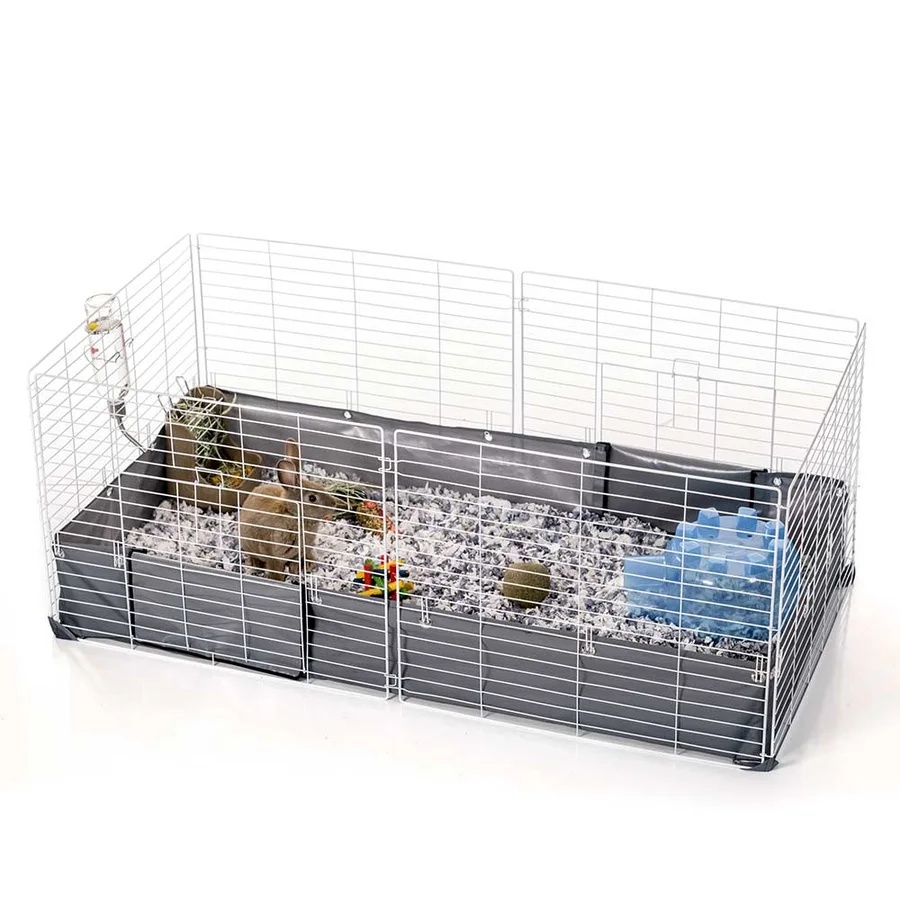
Kaytee Open Living Habitat — 60 × 30 Inch
Choose this as a lined indoor base if you plan manufacturer-supported expansion and appropriate roof and flooring—not as a complete single-unit home.

Three source-checked pen components compared for floor area, portability, expansion, and foot protection—not complete rabbit homes.
Last reviewed:
Buying a rabbit exercise pen starts with the space left after the litter tray, hides, hay, and water are installed—not the animal pictured on the box. These three existing catalog products have source-confirmed rabbit use, but their roughly 10–12.5-square-foot footprints are components or supervised play zones, not sufficient permanent homes on their own. We compare a folding pen, a playpen with published panel height, and a connectable lined base. No selected pen has a verified step-through door or escape-proof rating, and none should be treated as a predator-proof outdoor run.
Some links on this page are affiliate links. We may earn a commission if you buy through them, at no extra cost to you. This never changes our research or which products we recommend.

Choose this as a lined indoor base if you plan manufacturer-supported expansion and appropriate roof and flooring—not as a complete single-unit home.
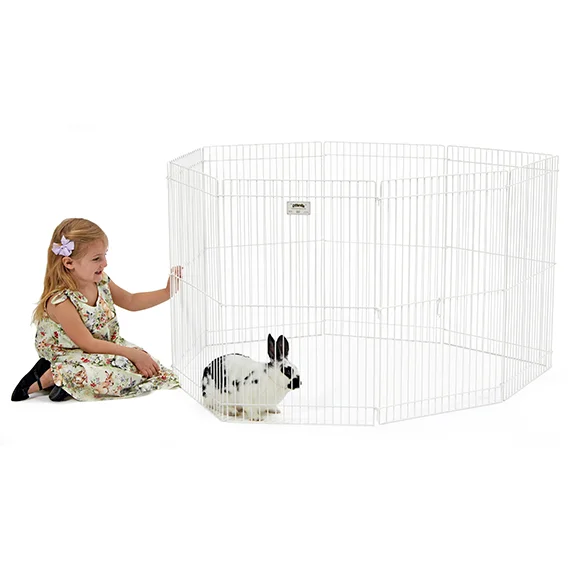
Choose this for documented fold-flat storage and supervised exercise. Its portability is verified; a price advantage or escape guarantee is not.
Filter by feature:

MidWest documents eight epoxy-coated panels, more than 10 square feet, 1-inch bar spacing, tool-free setup, and fold-flat storage. The maker includes rabbits in its species list but also describes use for non-jumping small animals. Do not read that as proof of rabbit containment: use this as a supervised exercise component, with secure positioning and a dry nonslip floor.
Why we recommend it
The clearest manufacturer-documented fold-flat option in this shortlist for occasional relocation and supervised exercise.
Pros
Cons
Best for
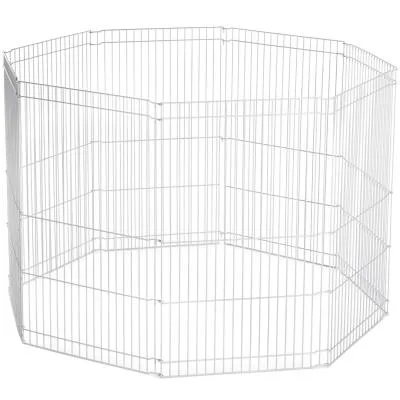
Prevue's 40094 playpen specifies 29-inch-high panels, 1-inch wire spacing, powder-coated steel mesh, and a stated 10-square-foot interior. It is intended for interactive play with rabbits and other small pets indoors or outdoors. Those dimensions help assess fit, but neither the height nor the rabbit label makes it escape-proof or adequate as the only living space.
Why we recommend it
Useful when a published panel height and wipe-clean steel construction are more informative than a vague extra-tall claim.
Pros
Cons
Best for

The 60-by-30-inch Kaytee Open Living variant has 12.5 square feet before furnishings, a removable waterproof clip-on liner, and manufacturer-supported connection to additional Open Living habitats. It is an open-top base component, not an entire exercise environment. Kaytee recommends its separately sold roof for rabbits; add safe traction, inspect the liner for chewing, and plan substantially more connected usable room.
Why we recommend it
The only selected system with both documented unit-to-unit expansion and an included removable waterproof liner.
Pros
Cons
Best for
Usable area before marketing size: Measure a continuous floor-level rectangle or the actual enclosed shape, then account for furnishings and dead ends. Kaytee's 60 × 30 inches equals 12.5 square feet before accessories; MidWest states more than 10 and Prevue states 10. These are not comparable claims about runnable space after setup. RWAF recommends a single living-area footprint at least 3 m × 2 m and 1 m high, available at all times, for two average-sized rabbits; it says a single rabbit still needs that space. A shelf, narrow connecting tunnel, or extra hour outside a small pen does not replace that continuous footprint.
Height is not an escape guarantee: Prevue publishes 29-inch panels; MidWest's page says extra tall without an exact height in the reviewed text. Rabbit athleticism, footholds, and nearby furniture matter as much as a height label. Place hides away from the boundary so they do not become launch platforms. Check mesh gaps for head or foot trapping, particularly with young or small rabbits. Kaytee recommends its optional roof for rabbits; confirm the correct accessory rather than improvising a loose cover.
Door and daily access: A true step-through door can make carrying a litter tray or reaching a rabbit easier than repeatedly stepping over a fence. We did not verify one on these exact products and award no door tag. Check the current model's door width, threshold, latch, and inward clearance before buying if accessible entry is essential. Do not select a low pen purely to make it easier for a person to climb over.
Anchoring and portability: A pen that folds flat is easier to store, but portability does not prove resistance to pushing. Test stability without the rabbit inside, secure the layout using manufacturer-compatible methods, and keep exposed fasteners out of reach. Do not assume anchors, a floor, or a roof are included. Indoors, prevent the pen sliding on smooth flooring. Outdoors, direct supervision, shade, safe temperature, nontoxic ground, and protection from digging and predators are separate requirements; stakes alone cannot provide them.
Expansion and foot protection: Kaytee explicitly allows additional Open Living units to connect; we did not verify a branded expansion system for the other two. Plan the final dimensions and connectors before buying, leaving a broad continuous movement area. Provide dry, solid, nonslip flooring with comfortable resting patches; exposed wire is not acceptable standing space. A waterproof liner protects the room but may still need traction above it. Secure edges, remove frayed textiles, and replace surfaces that are chewed or remain wet.
Not in one of these small units alone. A sufficiently large, safe, furnished pen system can be a home, but the selected single-unit footprints are only components or supervised play zones. RWAF recommends continuous access to at least 3 m × 2 m of floor space and 1 m height, including for a single rabbit.
It is a published dimension, not proof of containment. Some rabbits jump or climb, and a hide or chair near the edge can become a launch point. Assess the individual rabbit and the full layout; do not leave an unproven open setup unattended.
We have not verified a step-through door on any of these exact models. If you need one, confirm the current door opening, threshold height, and latch with the manufacturer before purchase rather than relying on photos of a similar pen.
No indoor/outdoor label establishes overnight safety. These open pens are not verified predator-proof runs. Outdoor exercise needs direct supervision and separate protection against escape, digging, predators, heat, cold, and unsafe plants.
It protects the underlying floor from moisture but does not automatically provide traction or comfortable resting support. Add secure nonslip footing, keep it dry, inspect for chewing, and never leave exposed wire as a standing surface.
Kaytee expressly supports connecting additional Open Living habitats. For other models, check approved connectors and stability rather than assuming compatibility. The final setup must provide a broad usable floor area, not just multiple small compartments joined by narrow passages.
Last reviewed:
This is desk research, not hands-on pen testing. We reused three rabbit-hutches catalog IDs whose manufacturer pages explicitly describe rabbit use, then compared published floor area, panel height where stated, storage, cleaning, liner inclusion, and supported expansion. We chose the larger Kaytee variant rather than counting near-identical sizes as separate recommendations. RWAF's space guidance and Rabbit.org's pen-flooring guidance provide welfare context, not endorsements of these models. Tags reflect documented features and tiers their use-case fit; we did not measure installed usable area, test jumping, climbing, anchoring, doors, predator resistance, liner durability, or current prices. Unverified doors and accessories receive no positive feature tag, and no sales-based popularity claim is made.